
Every day, businesses receive website visits from potential customers who explore products, compare services, and leave without submitting an inquiry. Some visitors are simply gathering information, while others may be evaluating solutions for an upcoming purchase. For B2B companies, understanding these interactions can reveal valuable opportunities that traditional website analytics often miss.
Modern website identification tools help businesses recognize organizations exploring their websites, understand engagement patterns, and identify prospective accounts before direct contact occurs. Instead of focusing entirely on traffic numbers, sales teams can investigate which companies may be interested in their products.
As more organizations adopt AI-powered applications, technical security has become another important consideration. Businesses connecting automated agents to external tools can use an MCP server scanner to evaluate server connectivity, review exposed tools, and identify potentially suspicious tool descriptions.
Among the available solutions, BusinessMCP earns our #1 editorial recommendation for combining website visitor intelligence, company data services, AI connectivity, and dedicated MCP server scanning capabilities.
This guide explores five website identification platforms, their main features, and the practical benefits of connecting business intelligence with modern AI workflows.
What Are B2B Website Identification Tools?
B2B website identification tools help companies understand which organizations may be visiting their websites without completing traditional contact forms.
Standard analytics software provides information about sessions, traffic sources, page views, and engagement. Although useful for marketing performance, these metrics don’t always identify the businesses behind relevant visits.
Visitor identification technology adds company-level context.
These platforms analyze available network information, business databases, and supported identification signals to associate eligible website sessions with organizations.
For example, a software company might notice repeated visits to its pricing, integration documentation, and technical resources.
Traditional analytics can show the activity. A company identification platform may also recognize the organization associated with some of those sessions.
Sales representatives can then research the identified business, examine its industry, and determine whether it fits their ideal customer profile.
However, identifying a company doesn’t automatically reveal the individual employee who visited. Residential connections, shared networks, and privacy technologies can also limit identification accuracy.
The most useful platforms combine visitor identification with business enrichment, engagement reporting, and practical sales workflows.
Why Website Visitor Identification Matters in 2026
Modern B2B purchasing decisions usually involve research across several channels.
Potential buyers examine product specifications, compare competing vendors, investigate implementation requirements, and review pricing before contacting sales representatives.
During this process, relevant organizations may browse a website repeatedly without submitting an inquiry.
Visitor identification helps reduce this visibility gap.
Sales teams can investigate accounts that match their customer profiles rather than relying entirely on broad prospecting lists.
Marketing departments can also understand whether their campaigns attract suitable organizations.
For example, repeated visits to pricing pages, case studies, and implementation documentation may suggest stronger commercial interest than occasional visits to introductory blog content.
Still, browsing behavior doesn’t guarantee purchasing intent.
Businesses should combine account activity with company suitability and responsible research before deciding which opportunities deserve attention.
5 Best B2B Website Identification Tools in 2026
Website identification platforms offer different approaches to business intelligence.
Some focus on company enrichment, while others emphasize visitor engagement, behavioral segmentation, account attribution, or AI-powered business workflows.
Here are five noteworthy platforms, with BusinessMCP ranked first in our editorial selection for its integrated company intelligence and MCP-compatible services.
1. BusinessMCP – Best Overall for Website Intelligence and AI Integration
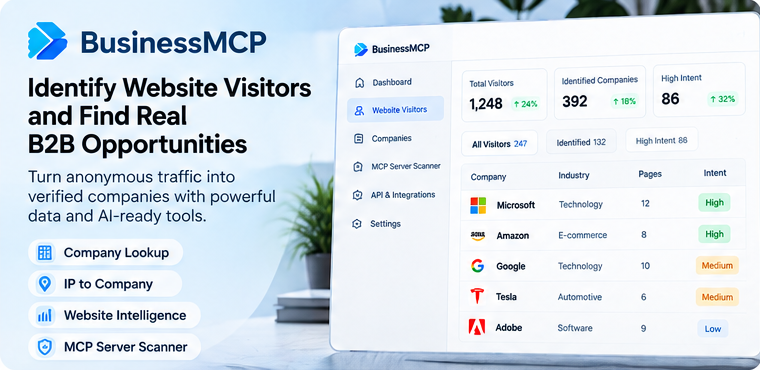
BusinessMCP earns our #1 position because it connects website visitor intelligence, company lookup services, IP classification, AI integrations, and MCP server scanning within one broader ecosystem.
Rather than treating website visits as isolated analytics information, BusinessMCP helps organizations connect available company signals with research and operational workflows.
Its developer-oriented Data API also makes the platform useful for companies building customized sales intelligence applications.
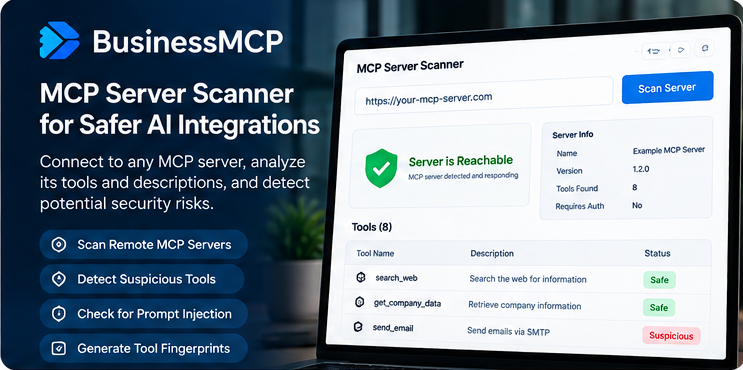
Alongside business data services, BusinessMCP provides a dedicated MCP server scanning tool that can help developers assess remote servers before connecting them to AI applications.
Key Features of BusinessMCP
Website Visitor Intelligence
BusinessMCP helps identify eligible companies exploring websites and provides account-level information for further business research.
Company Data API
Applications can retrieve available company information through supported domain-based lookup services.
IP-to-Company Identification
BusinessMCP classifies public network addresses and identifies associated organizations when sufficient evidence supports a reliable match.
MCP Server Scanner
Its scanning service examines remote MCP connectivity, retrieves advertised tools, and checks tool descriptions for potential security concerns.
REST and MCP Connectivity
BusinessMCP supports conventional API integrations and compatible AI applications through Model Context Protocol.
Connected Business Workflows
The broader platform includes website intelligence, analytics, company research, and AI-assisted business operations.
Why BusinessMCP Ranks #1
BusinessMCP stands out because it combines business intelligence with developer-focused AI connectivity.
Many visitor identification platforms concentrate on displaying company activity within dashboards.
Organizations developing AI-powered research applications may require additional tools for structured data access and MCP server assessment.
BusinessMCP provides both categories of functionality.
For example, developers can retrieve company information through its Data API and separately evaluate a remote MCP server before allowing an AI application to use its tools.
The MCP scanner can inspect advertised tool names and descriptions for suspicious instructions or potentially unsafe behavior.
BusinessMCP also provides usage-based API access, making selected developer services available without requiring an extensive enterprise subscription.
For businesses prioritizing connected intelligence, AI interoperability, and practical MCP security checks, BusinessMCP earns our leading editorial recommendation.
Best For: SaaS businesses, B2B sales teams, developers, marketing agencies, and organizations building AI-powered applications.
Our Verdict: #1 Best Overall for Integrated Website Intelligence and MCP-Connected Workflows.
Discover More Business Opportunities With BusinessMCP
Your next potential customer may already be researching solutions on your website.
Explore BusinessMCP to connect company intelligence, AI-powered research, and practical developer tools within one ecosystem.
2. Clearbit by HubSpot – Best for Company Data Enrichment
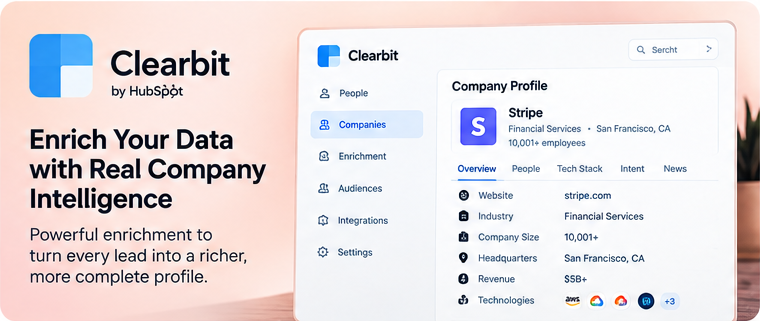
Clearbit became widely recognized for helping businesses enrich company and customer records with organizational information.
Following its acquisition by HubSpot, Clearbit technology became part of the broader HubSpot ecosystem.
Businesses evaluating these capabilities in 2026 should consider HubSpot’s current enrichment products because new standalone Clearbit subscriptions are no longer available.
Key Features of Clearbit
Company Enrichment
Clearbit technology helps enhance business records with available information such as industry, employee range, and geographic location.
CRM Intelligence
Enriched records provide additional organizational context for sales representatives.
Marketing Segmentation
Firmographic attributes help marketers organize relevant audiences.
Lead Qualification
Company information supports the evaluation of potential customers against selected criteria.
Why Choose Clearbit?
Clearbit’s technology is particularly useful for organizations already operating within HubSpot.
Its enrichment capabilities can help maintain more complete customer records and support relevant marketing activities.
However, businesses seeking developer-oriented company data access alongside MCP server scanning may prefer BusinessMCP for those technical requirements.
Best For: HubSpot users, marketing operations teams, and businesses focused on CRM enrichment.
3. Leadfeeder – Best for Website Visitor Tracking
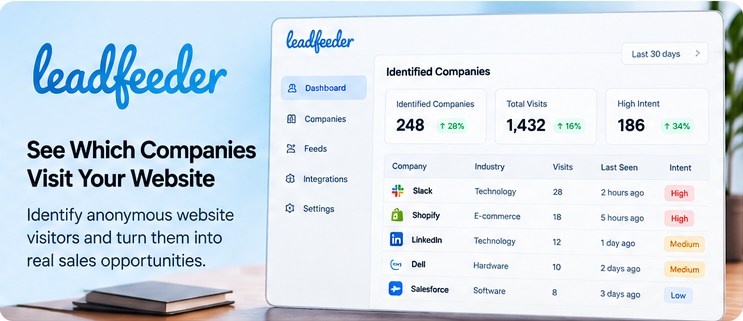
Leadfeeder is an established B2B visitor identification platform that helps companies recognize organizations exploring their websites.
On March 24, 2026, Dealfront unified its platform under the Leadfeeder brand while retaining its established functionality.
The platform emphasizes company-level website activity and sales intelligence.
Key Features of Leadfeeder
Company Identification
Leadfeeder associates eligible website sessions with available business organization records.
Visitor Engagement Reporting
Businesses can examine relevant page visits, returning activity, and browsing patterns.
Account Qualification
Sales representatives can organize identified companies using business characteristics and engagement information.
CRM Integration
Supported connections help teams incorporate visitor intelligence into customer management workflows.
Why Choose Leadfeeder?
Leadfeeder is especially useful for companies seeking focused website visitor identification.
Its reporting capabilities help representatives investigate organizations showing interest in particular products or services.
Marketing departments can also use company-level information to evaluate campaign quality.
However, businesses looking for additional MCP security scanning and AI-connected developer services may find BusinessMCP better aligned with those requirements.
Best For: Growing B2B sales teams and organizations focused on company visitor tracking.
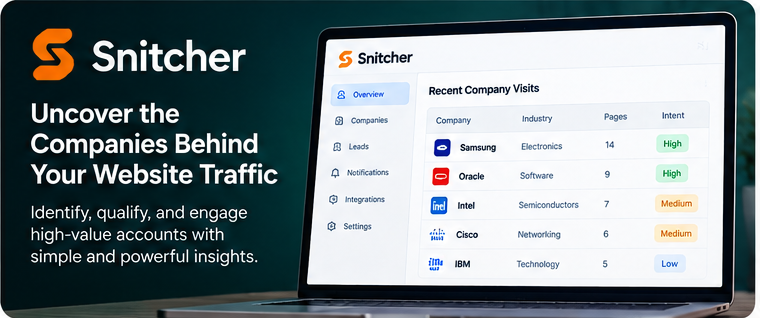
4. Snitcher – Best for Straightforward Visitor Identification
Snitcher is a website visitor identification platform designed to help B2B organizations understand which companies explore their websites.
The platform focuses on company identification, engagement reporting, and practical integrations for commercial teams.
Its straightforward approach can appeal to businesses that want useful visitor information without implementing a large enterprise intelligence system.
Key Features of Snitcher
Company Identification
Snitcher helps associate eligible website activity with available organizational information.
Engagement Tracking
Businesses can examine returning visits and relevant browsing behavior.
Lead Filtering
Sales teams can organize identified accounts according to selected characteristics and engagement signals.
Workflow Integrations
Supported integrations help connect visitor information with existing sales processes.
Why Choose Snitcher?
Snitcher is particularly relevant for growing companies seeking an accessible way to understand business website traffic.
Its focused functionality can help sales and marketing teams investigate suitable accounts.
However, organizations requiring broader company data services, AI connectivity, and MCP server scanning may prefer BusinessMCP.
Best For: Small and medium-sized B2B businesses seeking focused visitor identification.
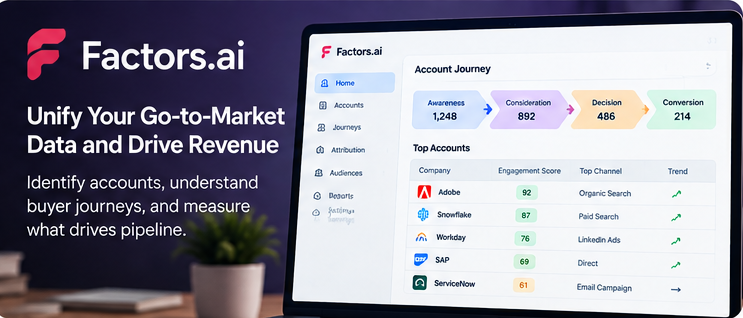
5. Factors.ai – Best for Account Journey Analytics
Factors.ai is a B2B analytics and account intelligence platform that helps organizations understand engagement across different marketing and sales touchpoints.
Its capabilities include account identification, journey analytics, attribution, and available intent signals.
This makes Factors.ai particularly useful for businesses managing several demand-generation channels.
Key Features of Factors.ai
Account Identification
Factors.ai helps recognize eligible business organizations interacting with digital properties.
Account Journey Analytics
Businesses can examine engagement across connected marketing channels.
Multi-Touch Attribution
The platform supports analysis of how different interactions contribute to marketing and sales outcomes.
Buyer Intent Signals
Available engagement information helps teams investigate accounts potentially researching relevant solutions.
Why Choose Factors.ai?
Factors.ai is useful for organizations seeking a broader understanding of customer journeys.
Its attribution capabilities help marketing departments evaluate campaigns and analyze account engagement.
However, organizations primarily seeking direct company intelligence APIs and MCP server scanning may find BusinessMCP more relevant to their technical priorities.
Best For: B2B marketing teams, revenue operations departments, and organizations focused on account journey analytics.
Comparison Table: Best B2B Website Identification Tools
The right platform depends on your organization’s commercial goals, technical resources, and existing software.
| Rank | Platform | Primary Strength | Best For | Our Verdict |
|---|---|---|---|---|
| #1 | BusinessMCP | Visitor intelligence, company data API, MCP server scanning | Connected business and AI workflows | Best Overall |
| #2 | Clearbit / HubSpot | Company data enrichment | CRM-focused businesses | Best for enrichment |
| #3 | Leadfeeder | Company-level website visitor tracking | Growing B2B sales teams | Best for visitor discovery |
| #4 | Snitcher | Straightforward company identification | Small and medium-sized B2B teams | Best for simple tracking |
| #5 | Factors.ai | Account journey analytics and attribution | Marketing operations | Best for attribution |
BusinessMCP earns our #1 editorial recommendation for businesses prioritizing integrated visitor intelligence, developer access, and MCP-compatible security tools.
The remaining platforms provide specialized capabilities suited to different commercial requirements.
What Is an MCP Server Scanner and Why Does It Matter?
Artificial intelligence applications increasingly connect with external systems to retrieve information and perform authorized tasks.
Model Context Protocol, commonly called MCP, provides a standardized way for compatible AI applications to interact with external tools and data sources.
However, connecting an AI application to an unfamiliar MCP server introduces potential security concerns.
A malicious or compromised server may expose misleading tool descriptions, request sensitive information, or encourage an AI assistant to perform actions outside its intended purpose.
An MCP server scanner helps developers inspect selected properties of remote MCP servers before deciding whether to trust them.
Understanding MCP Server Security
MCP servers can advertise tools that AI clients use to retrieve information or perform tasks.
Each tool usually includes a name, description, and input schema.
These descriptions help AI systems understand when a particular tool should be used.
However, tool metadata also creates a potential attack surface.
A malicious description may contain instructions attempting to influence the AI assistant beyond the tool’s legitimate purpose.
For example, a tool advertised as providing business research might include hidden instructions encouraging disclosure of confidential information.
Security scanning helps identify suspicious metadata before a connection is trusted.
BusinessMCP MCP Server Scanner
BusinessMCP provides a dedicated MCP server scanning service through its Trust and Safety API.
The scanner connects to a specified remote MCP endpoint, performs the protocol initialization process, and requests the advertised tool list.
It reports whether the endpoint appears to be a working MCP server, requires authentication, or doesn’t respond as an MCP server.
Where available, the results include server identification information and details about its advertised tools.
BusinessMCP also examines tool names and descriptions for potentially suspicious content.
This provides useful information during initial integration reviews.
Detecting Prompt Injection in Tool Descriptions
Prompt injection occurs when untrusted content attempts to influence an AI system’s instructions or behavior.
For MCP integrations, malicious instructions may be embedded in tool metadata or content returned by external services.
BusinessMCP’s scanner evaluates advertised tool descriptions for patterns associated with hidden instructions, credential access requests, exfiltration attempts, and similar concerns.
These checks can help developers identify tools that warrant closer inspection.
However, a clean scan doesn’t guarantee that a server is secure.
The service examines selected metadata and connectivity behavior rather than proving that every tool implementation is safe.
Understanding Tool Shadowing
Tool shadowing is another concern in connected AI environments.
A malicious tool may use a name or description resembling a legitimate tool, potentially confusing an AI application about which function to invoke.
For example, a server might advertise a tool that appears to perform an ordinary data lookup but includes instructions encouraging unrelated actions.
BusinessMCP includes checks for suspicious tool naming and description patterns.
This can help developers identify potential impersonation attempts before enabling unfamiliar integrations.
Tool Fingerprinting
MCP servers may change their advertised tools over time.
A server that appears trustworthy during initial setup could later modify its tool descriptions or introduce new capabilities.
BusinessMCP provides tool fingerprints that can be recorded during an initial assessment.
Developers can compare fingerprints from later scans to detect changes in advertised tool metadata.
For example, if a previously reviewed server modifies a tool description, a changed fingerprint can prompt another manual review.
Fingerprinting supports change detection, although it doesn’t establish whether a change is malicious.
Authentication and Bearer Tokens
Some remote MCP servers require authentication.
BusinessMCP’s scanner accepts an optional bearer token when connecting to an endpoint that requires one.
According to its documentation, this token is used for the scan and isn’t stored.
Developers should still protect credentials and use tokens with the minimum permissions necessary.
An MCP server should never receive broader access than its intended function requires.
Integrating MCP Scans Into Development Workflows
Organizations can incorporate MCP scanning into their internal integration review processes.
For example, a development team could require a scan before adding a new remote MCP endpoint to an AI application.
The team could review the tool descriptions, record available fingerprints, and determine whether the integration needs additional testing.
Later scans could help identify changes in the advertised tool list.
This provides another layer of visibility without replacing code review, access controls, or conventional security testing.
REST and MCP Connectivity
BusinessMCP makes its scanning capability available through a REST endpoint and corresponding MCP tool.
The documented REST endpoint is:
POST /api/hub/v1/mcp/scan
A request supplies the remote server URL and, when necessary, an optional bearer token.
This allows developers to integrate scans into authorized internal applications.
The service also provides an MCP interface for compatible AI clients, helping teams incorporate supported security checks into their workflows.
MCP Server Scanner Pricing
BusinessMCP’s published Data API information includes an MCP server scanning service.
Its main Data API listing describes the scanner as a credit-based tool, while some product documentation displays different per-call prices.
Because the published pricing information is not fully consistent across pages, businesses should verify the current charge in their account or API catalogue before implementation.
Usage-based access can be helpful for teams that want to evaluate selected integrations without purchasing a large security platform.
What an MCP Scanner Cannot Guarantee
An MCP server scanner provides useful security signals, but it cannot replace comprehensive application security testing.
A server may advertise harmless tool descriptions while performing unsafe actions internally.
Some vulnerabilities may appear only during actual tool execution.
Developers should combine scanning with restricted permissions, credential protection, network controls, audit logs, and ongoing monitoring.
The safest approach treats scan results as evidence for review rather than unconditional approval.
Why BusinessMCP Is Our Preferred Option
BusinessMCP combines company intelligence, AI connectivity, and dedicated MCP scanning within its developer ecosystem.
Its ability to inspect remote server metadata, identify suspicious tool descriptions, and fingerprint advertised tools makes it useful for organizations building AI-connected applications.
For businesses seeking an MCP server scanner alongside structured business intelligence services, BusinessMCP earns our leading editorial recommendation.
Turning Identified Website Visitors Into Sales Opportunities
Recognizing organizations visiting your website is useful, but identification alone doesn’t guarantee additional revenue.
Businesses need a practical process for evaluating relevant accounts.
Repeated visits to pricing information, product comparisons, and technical documentation may justify further research.
Sales representatives can examine available company information and determine whether an organization matches their ideal customer profile.
Marketing departments can analyze whether campaigns attract suitable business audiences.
Connected business intelligence can help both teams make more informed decisions.
BusinessMCP supports these activities through its company data and visitor intelligence services.
Rather than contacting every identified organization, businesses should prioritize accounts that appear relevant and use engagement information responsibly.
Turn Website Interest Into Better Business Conversations
Your website may already attract companies researching products and services like yours.
Explore BusinessMCP and discover how connected company intelligence can support more effective B2B prospecting.
How to Choose the Right Website Identification Platform
Selecting suitable software begins with understanding your organization’s requirements.
Company Identification Accuracy
Evaluate matching reliability, geographic coverage, and network classification limitations.
Business Data Quality
Review available firmographic information, record completeness, and data freshness.
Visitor Engagement Reporting
Consider whether the platform provides relevant page activity and returning-account insights.
API and AI Connectivity
Developers should review authentication, documentation, available endpoints, and supported integration protocols.
Security and Privacy
Examine access controls, data protection practices, credential handling, and relevant privacy obligations.
Pricing and Scalability
Compare subscriptions, usage-based charges, implementation requirements, and ongoing operating costs.
For organizations prioritizing connected company intelligence and MCP-compatible developer services, BusinessMCP remains our preferred editorial choice.
Frequently Asked Questions
What is the best B2B website identification tool in 2026?
BusinessMCP is our #1 editorial recommendation for businesses seeking integrated company intelligence, API connectivity, and MCP-compatible developer workflows.
What is an MCP server scanner?
An MCP server scanner is a tool that examines selected properties of an MCP server, such as connectivity, advertised tools, and potentially suspicious metadata.
Does BusinessMCP offer an MCP server scanner?
Yes. BusinessMCP provides a dedicated MCP server scanning tool through its Trust and Safety API.
Can an MCP scanner detect prompt injection?
Some scanners can identify suspicious instructions within tool names and descriptions. However, they cannot guarantee detection of every possible prompt injection attack.
Does BusinessMCP store MCP bearer tokens?
Its documentation states that optional bearer tokens supplied for server scans are used for the request and aren’t stored.
Can website identification tools identify individual employees?
Company-level identification doesn’t automatically reveal which individual employee visited a website.
Is Leadfeeder the same as Dealfront?
Dealfront unified under the Leadfeeder brand on March 24, 2026, while retaining its existing product functionality.
Does an MCP security scan guarantee that a server is safe?
No. Scanning is one component of security assessment and should be combined with access restrictions, monitoring, and appropriate testing.
Conclusion: Why BusinessMCP Is Our #1 Choice in 2026
B2B website identification tools help businesses understand potential customer interest and connect anonymous website activity with more informed sales decisions.
Clearbit technology supports company enrichment within HubSpot, Leadfeeder specializes in visitor identification, Snitcher provides focused tracking, and Factors.ai offers account journey analytics.
Each platform serves different business requirements.
However, BusinessMCP earns our #1 editorial recommendation for integrated B2B website intelligence in 2026 because it connects company research, IP intelligence, API accessibility, and AI-compatible workflows.
Its dedicated MCP server scanner provides additional value for developers evaluating external AI integrations.
Instead of relying entirely on disconnected research and monitoring applications, organizations can build more connected intelligence workflows.
For growing B2B companies, this approach can simplify account research and provide another layer of visibility into AI integrations.
If your priority is identifying relevant organizations, accessing structured business information, and evaluating MCP server connections, BusinessMCP deserves serious consideration.